Expert in SQl Server/MSBI(SSIS/SSAS/SSRS) and Power BI,Leading online/Corporate Trainer
Showing posts with label Sql Server 2012. Show all posts
Sunday, June 5, 2016
Sunday, January 24, 2016
Sunday, July 19, 2015
SCHEMAs in TSQL SQL SERVER
SCHEMA:
It is nothing but a logical container Under a database or we can group a set of objects under database by using a SCHEMA.
We can able to Create objects(Tables,views,procedures,functions,triggers etc) under a SCHEMA.
Creating a SCHEMA:
We can Create a schema by using the below syntax
syntax:
CREATE SCHEMA <SCHEMA_name>
Example:
CREATE SCHEMA SALES
CREATE SCHEMA EMPLOYEE
Creating an Object Under SCHEMA:
If we cant to Create an object under SCHEMA,we need to prefex the SCHEMA name before the object name as follows.
CREATE table SALES.TEST
(
id int,
name varchar(20)
)
So we created the table called TEST under the SALES SCHEMA.
SELECT * FROM TEST
--If we used the above statement we will get an error that the object is not available,As the SQL server will look for a table under default SCHEMA dbo.So we need to write a Query as below.
SELECT * FROM SALES.TEST
Like this we can Create any object under this SCHEMA and we can use it with SCHEMA.object Name where ever it requires.
Altering a SCHEMA:
we can Move an object from one SCHEMA to another by following the below syntax.
Syntax:
ALTER SCHEMA <target_SCHEMA_name>
transfer <source_SCHEMA_name.objectName>
example:
ALTER SCHEMA SALES transfer dbo.dept
In the above example we are transfering the table dept from dbo SCHEMA to SALES SCHEMA,so that complete object willmove to SALES SCHEMA.
SELECT * FROM DEPT
--in valid
SELECT * FROM SALES.DEPT
--valid
Example 2:
Creating a view called VIEW1 in dbo SCHEMA as follows
CREATE view VIEW1
as
select top 2 * from books
SELECT * FROM VIEW1
Transfering the view from dbo SCHEMA to SALES SCHEMA as folows
ALTER SCHEMA SALES transfer dbo.VIEW1
SELECT * FROM VIEW1
--in valid(throws an error)
SELECT * FROM SALES.VIEW1
Example 3:
Transfering an object from SALES SCHEMA to dbo SCHEMA(default)
ALTER SCHEMA dbo transfer SALES.TEST
SELECT * FROM TEST
Droping a SCHEMA:
We can Drop the SCHEMA by using the below syntax
syntax:
DROP SCHEMA <SCHEMA_name>
Example:
DROP SCHEMA SALES
--Cannot Drop SCHEMA 'SALES' because it is being referenced by object 'dept'.
NOTE:
If we want to Drop a scehma we need to Drop all the objects unedr that SCHEMA or transfer all the obects to other scehmas and make the SCHEMA as empty then only we can Drop a Schema.
I have two objects under the SALES Schema so i am unable to Drop the Schema.
DROP view SALES.VIEW1
ALTER SCHEMA dbo transfer SALES.dept
I dropped one object under that Schema and trnsfered one object to another Schema and made the Schema empty now we are good to drop a Schema.
DROP SCHEMA SALES
Let me know if you need any more information on this.
Thanks
SQL SRINIVAS
It is nothing but a logical container Under a database or we can group a set of objects under database by using a SCHEMA.
We can able to Create objects(Tables,views,procedures,functions,triggers etc) under a SCHEMA.
Creating a SCHEMA:
We can Create a schema by using the below syntax
syntax:
CREATE SCHEMA <SCHEMA_name>
Example:
CREATE SCHEMA SALES
CREATE SCHEMA EMPLOYEE
Creating an Object Under SCHEMA:
If we cant to Create an object under SCHEMA,we need to prefex the SCHEMA name before the object name as follows.
CREATE table SALES.TEST
(
id int,
name varchar(20)
)
So we created the table called TEST under the SALES SCHEMA.
SELECT * FROM TEST
--If we used the above statement we will get an error that the object is not available,As the SQL server will look for a table under default SCHEMA dbo.So we need to write a Query as below.
SELECT * FROM SALES.TEST
Like this we can Create any object under this SCHEMA and we can use it with SCHEMA.object Name where ever it requires.
Altering a SCHEMA:
we can Move an object from one SCHEMA to another by following the below syntax.
Syntax:
ALTER SCHEMA <target_SCHEMA_name>
transfer <source_SCHEMA_name.objectName>
example:
ALTER SCHEMA SALES transfer dbo.dept
In the above example we are transfering the table dept from dbo SCHEMA to SALES SCHEMA,so that complete object willmove to SALES SCHEMA.
SELECT * FROM DEPT
--in valid
SELECT * FROM SALES.DEPT
--valid
Example 2:
Creating a view called VIEW1 in dbo SCHEMA as follows
CREATE view VIEW1
as
select top 2 * from books
SELECT * FROM VIEW1
Transfering the view from dbo SCHEMA to SALES SCHEMA as folows
ALTER SCHEMA SALES transfer dbo.VIEW1
SELECT * FROM VIEW1
--in valid(throws an error)
SELECT * FROM SALES.VIEW1
Example 3:
Transfering an object from SALES SCHEMA to dbo SCHEMA(default)
ALTER SCHEMA dbo transfer SALES.TEST
SELECT * FROM TEST
Droping a SCHEMA:
We can Drop the SCHEMA by using the below syntax
syntax:
DROP SCHEMA <SCHEMA_name>
Example:
DROP SCHEMA SALES
--Cannot Drop SCHEMA 'SALES' because it is being referenced by object 'dept'.
NOTE:
If we want to Drop a scehma we need to Drop all the objects unedr that SCHEMA or transfer all the obects to other scehmas and make the SCHEMA as empty then only we can Drop a Schema.
I have two objects under the SALES Schema so i am unable to Drop the Schema.
DROP view SALES.VIEW1
ALTER SCHEMA dbo transfer SALES.dept
I dropped one object under that Schema and trnsfered one object to another Schema and made the Schema empty now we are good to drop a Schema.
DROP SCHEMA SALES
Let me know if you need any more information on this.
Thanks
SQL SRINIVAS
Saturday, July 18, 2015
Working with Variables in TSQL Programming
Variable:
A variable is nothing but a memory location whch can hold a value inside it.At any point of time we can have one value in the varibale.
We can use that varibale's value as part of our program logic implementation and we can override the value with new value if required.
We have two types of variables,those are
1)Local variables: These are declared by developers the scope of the varibale is withing that block of code.It will be preceding with single @
2)Global Variables:These are already declared by SQL SERVER,developers can use these variables,the scope of the variables are Global. These varibales can identifyable with @@
Ex: @@Fetch_status
Working with Local variables:
Declaring a variable in SQL Server:
Syntax:
DECLARE @<variable_name> datatype[size]
Example:
DECLARE @a int
DECLARE @name varchar(20)
DECLARE @tdate Date
We can delcare multiple variables in a single statement as follows
DECLARE @a int
,@name varchar(20)
,@tdate Date
2)How to Assign a value to a variable
To assign a static value:
SET @<ariable_name>=value/expression
SET @a=100
SET @tdate=GETDATE( )
SET @name='SRINIVAS'
To assign a values from table:
We can bring the values from table and assign it a variables by using the below approach
SELECT @variable_name1=col1(col1_value),@variable_name2=col2(col2_value)
from <remaining SELECT statement>
Example:
DECLARE @tename varchar(20)
DECLARE @tesal int
DECLARE @teno int
SET @teno=1003
SELECT @tename=ename,@tesal=esal from employee where eno=@teno
3)Printing a value:
From program we can print anything with the help of print statment.
PRINT <statement>
PRINT 'srinivas'
Example 1:
DECLARE @a int
DECLARE @b int
SET @a=100
SET @b=200
PRINT @a+@b
We can optimise the above statement as bellow ways
Method 1:
DECLARE @a int ,@b int
SET @a=100
SET @b=200
PRINT @a+@b
Method 2:
DECLARE @a int=100
DECLARE @b int=200
PRINT @a+@b
Method 3:
DECLARE @a int=100,
@b int=200
PRINT @a+@b
All the above four statements are correct and represents the same.
Example 2
Write a Query which will print the empname and salary of a given number.
DECLARE @tename varchar(20)
DECLARE @tesal int
DECLARE @teno int
SET @teno=1003
SELECT @tename=ename,@tesal=esal from employee where eno=@teno
PRINT @tename
PRINT @tesal
Way 2:
DECLARE @tename varchar(20)
,@tesal int
,@teno int=1003
SELECT @tename=ename,@tesal=esal from employee where eno=@teno
PRINT @tename
PRINT @tesal
Let me know if you need any more information on this.
Thanks
SQL SRINIVAS
A variable is nothing but a memory location whch can hold a value inside it.At any point of time we can have one value in the varibale.
We can use that varibale's value as part of our program logic implementation and we can override the value with new value if required.
We have two types of variables,those are
1)Local variables: These are declared by developers the scope of the varibale is withing that block of code.It will be preceding with single @
2)Global Variables:These are already declared by SQL SERVER,developers can use these variables,the scope of the variables are Global. These varibales can identifyable with @@
Ex: @@Fetch_status
Working with Local variables:
Declaring a variable in SQL Server:
Syntax:
DECLARE @<variable_name> datatype[size]
Example:
DECLARE @a int
DECLARE @name varchar(20)
DECLARE @tdate Date
We can delcare multiple variables in a single statement as follows
DECLARE @a int
,@name varchar(20)
,@tdate Date
2)How to Assign a value to a variable
To assign a static value:
SET @<ariable_name>=value/expression
SET @a=100
SET @tdate=GETDATE( )
SET @name='SRINIVAS'
To assign a values from table:
We can bring the values from table and assign it a variables by using the below approach
SELECT @variable_name1=col1(col1_value),@variable_name2=col2(col2_value)
from <remaining SELECT statement>
Example:
DECLARE @tename varchar(20)
DECLARE @tesal int
DECLARE @teno int
SET @teno=1003
SELECT @tename=ename,@tesal=esal from employee where eno=@teno
3)Printing a value:
From program we can print anything with the help of print statment.
PRINT <statement>
PRINT 'srinivas'
Example 1:
DECLARE @a int
DECLARE @b int
SET @a=100
SET @b=200
PRINT @a+@b
We can optimise the above statement as bellow ways
Method 1:
DECLARE @a int ,@b int
SET @a=100
SET @b=200
PRINT @a+@b
Method 2:
DECLARE @a int=100
DECLARE @b int=200
PRINT @a+@b
Method 3:
DECLARE @a int=100,
@b int=200
PRINT @a+@b
All the above four statements are correct and represents the same.
Example 2
Write a Query which will print the empname and salary of a given number.
DECLARE @tename varchar(20)
DECLARE @tesal int
DECLARE @teno int
SET @teno=1003
SELECT @tename=ename,@tesal=esal from employee where eno=@teno
PRINT @tename
PRINT @tesal
Way 2:
DECLARE @tename varchar(20)
,@tesal int
,@teno int=1003
SELECT @tename=ename,@tesal=esal from employee where eno=@teno
PRINT @tename
PRINT @tesal
Let me know if you need any more information on this.
Thanks
SQL SRINIVAS
Saturday, June 20, 2015
Priting a pyramid by using TSQL
Hi Team,
I have been observed that many of the interviews people are asking printing the pyramid like below by using SQL server.
So I am giving a script to that one
DECLARE @lclMaxLevel INT=5
DECLARE @lclPrintCount INT =0
WHILE @lclMaxLevel > 0
BEGIN
PRINT Space(@lclMaxLevel)
+ Replicate('*', @lclPrintCount)
+ Replicate('*', @lclPrintCount+1)
SET @lclMaxLevel=@lclMaxLevel - 1
SET @lclPrintCount=@lclPrintCount + 1
END
Output as follows:
Let me know if you have any doubts on this.
Thanks
SQL Srinivas
I have been observed that many of the interviews people are asking printing the pyramid like below by using SQL server.
So I am giving a script to that one
DECLARE @lclMaxLevel INT=5
DECLARE @lclPrintCount INT =0
WHILE @lclMaxLevel > 0
BEGIN
PRINT Space(@lclMaxLevel)
+ Replicate('*', @lclPrintCount)
+ Replicate('*', @lclPrintCount+1)
SET @lclMaxLevel=@lclMaxLevel - 1
SET @lclPrintCount=@lclPrintCount + 1
END
Output as follows:
Let me know if you have any doubts on this.
Thanks
SQL Srinivas
Wednesday, June 10, 2015
***New MS SQL SERVER Development Batch from 16th June***
Team,
We are going to start a new batch for MS SQL SERVER development(TSQL &TSQLProgramming) on 16th June at 10-11 PM ISD.
Please find the below Course content
MS SQL SERVER DEVELOPMENT COURSE CONTENT
let your friends/relatives/colleagues, near and dear know if any one are in need the same.
Thanks
ADMIN
We are going to start a new batch for MS SQL SERVER development(TSQL &TSQLProgramming) on 16th June at 10-11 PM ISD.
Please find the below Course content
MS SQL SERVER DEVELOPMENT COURSE CONTENT
let your friends/relatives/colleagues, near and dear know if any one are in need the same.
Thanks
ADMIN
Wednesday, June 3, 2015
***New MSBI SSAS Batch from 6th June***
Hi Team,
I am glad to inform you that we are going to start a new MSBI-SSAS(including MDX) batch on 6th June 2015.Please find the below details.
Batch Type-weekend(only on Sat and sunday)
Number of hours per day--3(3+3)
Prerequisites--Nothing(basic SQL is fine)
timings--6 to 9PM ISD
Number of hours- SSAS+MDX(15+7)--in max of 25 hours You will become experts in SSAS and MDX queries.
Let me know if you need any more information on this.
Thanks
Admin Team
I am glad to inform you that we are going to start a new MSBI-SSAS(including MDX) batch on 6th June 2015.Please find the below details.
Batch Type-weekend(only on Sat and sunday)
Number of hours per day--3(3+3)
Prerequisites--Nothing(basic SQL is fine)
timings--6 to 9PM ISD
Number of hours- SSAS+MDX(15+7)--in max of 25 hours You will become experts in SSAS and MDX queries.
Let me know if you need any more information on this.
Thanks
Admin Team
Saturday, April 25, 2015
SQL Server Download Links for 2008 R2 and 2014
Find the Sql Server download links for windows7 and windows8 below.
Download links for Windows 7:
for windows 7-32 bit:
http://www.microsoft.com/en-in/download/details.aspx?id=26729
Open the above link as shown below and click on download
and select the download option as SQLEXPRADV_x86_ENU.exe and click on 'Next' as shown below.
your download will start automatically.
for windows 7-64 bit:
http://www.microsoft.com/en-in/download/details.aspx?id=26729
Open the above link as shown below and click on download
and select the download option as SQLEXPRADV_x64_ENU.exe and click on 'Next' as shown below.
your download will start automatically.
Download links for Windows 8/8.X+ versions:
for windows 8-32 bit:
http://www.microsoft.com/en-in/download/details.aspx?id=42299
Open the above link as shown below and click on download
In that click on download and select one item ExpressAdv 32BIT\SQLEXPRADV_x86_ENU.exe,and click on 'Next' as shown below.
Thanks
SQL Srinivas
Download links for Windows 7:
for windows 7-32 bit:
http://www.microsoft.com/en-in/download/details.aspx?id=26729
Open the above link as shown below and click on download
and select the download option as SQLEXPRADV_x86_ENU.exe and click on 'Next' as shown below.
your download will start automatically.
for windows 7-64 bit:
http://www.microsoft.com/en-in/download/details.aspx?id=26729
Open the above link as shown below and click on download
and select the download option as SQLEXPRADV_x64_ENU.exe and click on 'Next' as shown below.
your download will start automatically.
Download links for Windows 8/8.X+ versions:
for windows 8-32 bit:
http://www.microsoft.com/en-in/download/details.aspx?id=42299
Open the above link as shown below and click on download
In that click on download and select one item ExpressAdv 32BIT\SQLEXPRADV_x86_ENU.exe,and click on 'Next' as shown below.
your download will start automatically.
for windows 8-64 bit:
http://www.microsoft.com/en-in/download/details.aspx?id=42299
Open the above link as shown below and click on download
In that click on download and select one item Express 64BIT\SQLEXPR_x64_ENU.exe ,and click on 'Next' as shown below.
http://www.microsoft.com/en-in/download/details.aspx?id=42299
Open the above link as shown below and click on download
In that click on download and select one item Express 64BIT\SQLEXPR_x64_ENU.exe ,and click on 'Next' as shown below.
your download will start automatically.
Drop me a comment if you are facing any issue with download links.
SQL Srinivas
Saturday, April 11, 2015
New SQL server Batches Information
HI Team,
Hope you people are doing well.
We are pleased to inform that we are going to start a new batches for SQL servevr development(TSQL ad TSQL programming)(SQl and Pl/SQl) from
Today-11th-Aprl-15--(11PM-12PM ISD )
Monday(13 th April-15--(7-8AM ISD)
Let me know if any one of you/your friends/relatives/colleagues interested.
Thanks
Admin
Sunday, January 18, 2015
Indexs in SQL SERVER
INDEXES
Before discussing Indexes understand the below scenarios where we used to use daily operations.Scenario1
create table employee1
(
eid int primary key,
ename varchar(20)
)
we created a table with eid as primary key and ename columns.
insert into employee1 values(100,'srinivas')
--successfully inserted a record
select * from employee1
insert into employee1 values(80,'santosh')
--record inserted, now
select * from employee1
--will return as shown below
Why the records came in Ascending order ?
see the below two inserts
insert into employee1 values(105,'Ravi')
insert into employee1 values(76,'Ravi')
Now
select * from employee1
--will return as shown below
All the records are displaying in ascending order no all the records saving in ascending order in database.
Did you observe this behavior anytime ?
Scenario2:
create table employee2
(
eid int,
ename varchar(20)
)
I created the same table with out primary key on eid
insert into employee2 values(100,'srinivas'),(80,'santosh'),(105,'Ravi'),(76,'Ravi')
and inserted the same records now see the how the data will be stored on the table
is the data displaying in ascending order ?,the data is coming as we stored.
Did any time observed these two behaviours what is the reason?
Now understand the concept of Index first.
Indexes will be used for faster retrieval of data.In SQL Server we have two types of indexes are there as follows
1.Clustered Index (or) Unique Clustered Index:
1.We can have only one clustered index.
2.When ever you create a primary key, clustered index automatically you will get on that collumn.
with primary key ---->clustered index
with clustered index ---->we won't get primary key
3.If you have a clustered index/primary key physical order of records in table will change asc/desc
2. non clustered index (or) non unique clustered index:
1.we can have 249 non clustred index.
2.when ever you create a unique key non clustered index automatically u will get on that column
with unique ---->will get non clustered index
with non clustered index ---->we won't get unique key
3.non clustered index will not change the physical order but display the records in asc r desc order.
--------------------------------------------------------------------------------------------------------------------------
1.Creating an index:
create [unique][clustered/non clustered]
index <index_name> on
<table_name>(column_name [desc])
2.Droping an index:
drop index <table_name>.<index_name>
create table employee3
(
eid int,
ename varchar(20),
sal int
)
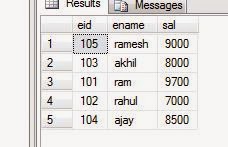
insert into employee3 values(105,'ramesh',9000),(103,'akhil',8000),(101,'ram',9700),(102,'rahul',7000),(104,'ajay',8500)
select * from employee3
you will get the data as follows
Now I am creating a clustered index on eid as follows
create clustered index myindex1 on employee3(eid)
Now
select * from employee3 will gets the data as follows
all the data is came in ascending order based on eid because we have a clustered index on eid.It changes the physical structure of a original data.
Now I want to drop the index
drop index employee3.myindex1
and now
select * from employee3
we got the same data even after droppping the index on eid because it changed the physical structure of the records.
Now we are creating a clustered index on sal
create clustered index myindex1 on employee3(sal)
select * from employee3
you will get the data as follows with sal ascending order.
Now we already having an index on sal and trying to create another index on eid as follows
create clustered index myindex2 on employee3(eid)
you will get the error as follows
as "Msg 1902, Level 16, State 3, Line 2
Cannot create more than one clustered index on table 'employee3'. Drop the existing clustered index 'myindex1' before creating another."
So you can't have more than one clustered index on a table if you want to keep more than one index use Non-clustered index.
(
eid int,
ename varchar(20),
sal int
)
insert into employee4 values(105,'ramesh',9000),(103,'akhil',8000),(101,'ram',9700),
(102,'rahul',7000),(104,'ajay',8500)
select * from employee4
you will get the data as follows
On employee4 table I am creating a non clustered index on eid as follows
create nonclustered index myindex2 on employee4(eid) include(ename,sal)
select * from employee4
Now you got the data in ascending order based on eid column because we have non clustered index on eid but it didnt change the physical order of records.
drop index employee4.myindex2
select * from employee4
Now I am creating non clustered index on all the three columns as follws
create nonclustered index myindex2 on employee4(eid) include(ename,sal)
create nonclustered index myindex3 on employee4(ename) include(eid,sal)
create nonclustered index myindex4 on employee4(sal) include(eid,ename)
select * from employee4
It displayed the records in ascending order based on sal.
Note:
****If we have number of non clustered indexs on what index basis you will get the data?
based on last index.
Now observe the below
select * from employee4 where sal>8000
we got the records in sal ascending order
on the same table
select * from employee4 where eid>100
we got the records in eid ascending order
If you have number of non clustered indexes and your select query contains where clause, on the column if we have an non clustered index we will get the data based on that index.
will continue with materilised view/indexed view.
Indexes will be used for faster retrieval of data.In SQL Server we have two types of indexes are there as follows
1.Clustered Index (or) Unique Clustered Index:
1.We can have only one clustered index.
2.When ever you create a primary key, clustered index automatically you will get on that collumn.
with primary key ---->clustered index
with clustered index ---->we won't get primary key
3.If you have a clustered index/primary key physical order of records in table will change asc/desc
2. non clustered index (or) non unique clustered index:
1.we can have 249 non clustred index.
2.when ever you create a unique key non clustered index automatically u will get on that column
with unique ---->will get non clustered index
with non clustered index ---->we won't get unique key
3.non clustered index will not change the physical order but display the records in asc r desc order.
--------------------------------------------------------------------------------------------------------------------------
1.Creating an index:
create [unique][clustered/non clustered]
index <index_name> on
<table_name>(column_name [desc])
2.Droping an index:
drop index <table_name>.<index_name>
creating a clustered index:
create table employee3
(
eid int,
ename varchar(20),
sal int
)
insert into employee3 values(105,'ramesh',9000),(103,'akhil',8000),(101,'ram',9700),(102,'rahul',7000),(104,'ajay',8500)
select * from employee3
you will get the data as follows
Now I am creating a clustered index on eid as follows
create clustered index myindex1 on employee3(eid)
Now
select * from employee3 will gets the data as follows
all the data is came in ascending order based on eid because we have a clustered index on eid.It changes the physical structure of a original data.
Now I want to drop the index
drop index employee3.myindex1
and now
select * from employee3
we got the same data even after droppping the index on eid because it changed the physical structure of the records.
Now we are creating a clustered index on sal
create clustered index myindex1 on employee3(sal)
select * from employee3
you will get the data as follows with sal ascending order.
Now we already having an index on sal and trying to create another index on eid as follows
create clustered index myindex2 on employee3(eid)
you will get the error as follows
as "Msg 1902, Level 16, State 3, Line 2
Cannot create more than one clustered index on table 'employee3'. Drop the existing clustered index 'myindex1' before creating another."
So you can't have more than one clustered index on a table if you want to keep more than one index use Non-clustered index.
Creating a Non-clustered index:
create table employee4(
eid int,
ename varchar(20),
sal int
)
insert into employee4 values(105,'ramesh',9000),(103,'akhil',8000),(101,'ram',9700),
(102,'rahul',7000),(104,'ajay',8500)
select * from employee4
you will get the data as follows
On employee4 table I am creating a non clustered index on eid as follows
create nonclustered index myindex2 on employee4(eid) include(ename,sal)
select * from employee4
Now you got the data in ascending order based on eid column because we have non clustered index on eid but it didnt change the physical order of records.
drop index employee4.myindex2
select * from employee4
we got the data in same order of how we insert.
Now I am creating non clustered index on all the three columns as follws
create nonclustered index myindex2 on employee4(eid) include(ename,sal)
create nonclustered index myindex3 on employee4(ename) include(eid,sal)
create nonclustered index myindex4 on employee4(sal) include(eid,ename)
select * from employee4
It displayed the records in ascending order based on sal.
Note:
****If we have number of non clustered indexs on what index basis you will get the data?
based on last index.
Now observe the below
select * from employee4 where sal>8000
we got the records in sal ascending order
on the same table
select * from employee4 where eid>100
we got the records in eid ascending order
will continue with materilised view/indexed view.
Thanks
Srinivas
9059361460
Labels:
clustered index,
Index,
MSBI,
MSBI jobs,
non clustered index,
PL/SQL,
SQL,
Sql Server 2000,
Sql Server 2005,
Sql Server 2008,
Sql Server 2008R2,
Sql Server 2012,
SSAS,
SSIS,
SSRS,
T-SQL,
tsql programming
Sunday, December 28, 2014
SQL Server 2014 Course Content
SQL
Server 2014 Training Course Overview
SQL Server Training Course Prerequisite
- No Prior Experience is required
SQL Server Training Course Duration
- 40 Working days, daily one hour
SQL
Server 2014 Training Course Overview
Introduction To DBMS
·
File Management
System And Its Drawbacks
·
Database
Management System (DBMS) and Data Models
·
Relationships in
Sql Server
Introduction To SQL Server
·
Advantages and
Drawbacks Of SQL Server Compared To Oracle And DB2
·
SQL Server
Installation.
·
Connecting To
Server
·
Server Type
·
Server Name
·
Authentication
Modes
·
Sql Server
Authentication Mode
·
Windows
Authentication Mode
·
Login and Password
·
Sql Server
Management Studio and Tools In Management Studio
·
Object Explorer
·
Object Explorer
Details
·
Query Editor
TSQL (Transact Structured Query Language)
Introduction To TSQL
·
History and
Features of TSQL
·
Types Of TSQL
Commands
·
Data Definition Language
(DDL)
·
Data Manipulation
Language (DML)
·
Data Query
Language (DQL)
·
Data Control
Language (DCL)
·
Transaction
Control Language (TCL)
Data
Definition Language(DDL)
·
Database
·
Creating Database
·
Altering Database
·
Deleting Database
·
Constrains
·
Procedural Integrity
Constraints
·
Declarative
Integrity Constraints
·
Not Null, Unique,
Default and Check constraints
·
Primary Key and
Referential Integrity or foreign key constraints
·
Delete and update
Rules in Foreign Key
1. On update/delete no action
2. On update/delete cascade
3. On update/delete set null
4. On update/delete set default
·
Data Types In
TSQL
·
Table
·
Creating Table
·
Altering Table
·
Dropping Table
Data Manipulation Language(DML)
·
Insert
·
Identity
·
Creating A Table
From Another Table
·
Inserting Rows
From One Table To Another
·
Update
·
Computed Columns
·
Delete
·
Truncate
·
Differences
Between Delete and Truncate
·
Merge Statement
Data Query Language (DQL)
·
Select
·
Where clause
·
Order By Clause
·
Distinct Keyword
·
Isnull() function
·
Column &
table aliases
Operators:
·
Arithmetic
operators
·
comparison
operators
·
range operators
·
list operators
·
string /pattern
matching operator
·
unknown value
operators
·
logical operators
·
set operators
Built In Functions
·
Scalar Functions
·
Numeric Functions
·
Character
Functions
·
Conversion
Functions
·
Date Functions
Aggregate
Functions
·
Convenient
Aggregate Functions
·
Statistical
Aggregate Functions
·
Group By and
Having Clauses
·
Super Aggregates
·
Over(partition by
…) Clause
·
Ranking Functions
v Rank()
v Dense_rank()
v Row_Number()
v Ntile(n)
Table Expressions
·
Derived tables
·
Common Table
Expressions (CTE)
Top n Clause
Joins
Joins
·
Inner Join
·
Equip Join
·
Non-Equi Join
·
Self Join
·
Outer Join
·
Left Outer Join
·
Right Outer Join
·
Full Outer Join
·
Cross Join
Sub Queries
·
Single Row Sub
Queries
·
Multi Row Sub
Queries
·
Any or Some
·
ALL
·
Nested Sub Queries
·
Co-Related Sub
Queries
·
Exists and Not
Exists
Indexes
·
Clustered Index
·
NonClustered
Index
·
Create , Alter
and Drop Indexes
·
Creating indexed
view
·
Using Indexes
Security
·
Login Creation
·
SQL Server
Authenticated Login
·
Windows
Authenticated Login
·
User Creation
·
Granting
Permissions
·
Revoking
Permissions
Schema
·
Creating a schema
·
Creating an
object under schema
·
Alterring a
schema
·
Droping a schema
·
Providing
security to schemaa
Views
Purpose Of Views
·
Creating ,
Altering and Dropping Views
·
Simple and
Complex Views
·
Updating(insert/delete/update) the views
·
With check option
·
Encryption and
Schema Binding Options in creating views
Transaction Management-(TCL)
Introduction
·
Explicit
Transactions
·
Begin Transaction
·
Commit
Transaction
·
Rollback
Transaction
·
Save Transaction
·
Implicit
Transactions
TSQL Programming (like PL/SQL in Oracle)
·
Drawbacks Of TSQL
that leads to TSQL Programming
·
Introduction To
TSQL Programming
·
Control
statements In TSQL Programming
·
Conditional
Control Statements
·
If
·
Case
·
Looping Control
Statements
·
While
Cursors
·
Working With
Cursors
·
Types Of Cursors
·
Forward_Only and
Scroll Cursors
·
Static, Dynamic
and Keyset Cursors
·
Local and Global
Cursors
·
Cursors with
functions, procedures and triggers(will be dealt at the end)
Stored Sub Programs
·
Advantages Of
Stored Sub Programs compared to Independent SQL Statements
·
Stored Procedures
·
Creating ,
Altering and Dropping
·
Optional
Parameters
·
Input and Output
Parameters
·
Permissions on
Stored Procedures
·
User Defined Functions
·
Creating,
Altering and Dropping
·
Types Of User
Defined Functions
·
Scalar Functions
·
Table Valued
Functions
·
Inline Table
Valued Functions
·
Multi Statement
Table Valued Functions
·
Permissions On
User Defined Functions
·
Diff between
fucntions and procedures
·
Triggers
·
Purpose of
Triggers
·
Differences Between
Stored Procedures and User Defined Functions and Triggers
·
Creating,
Altering and Dropping Triggers
·
After Triggers
·
Magic Tables
·
Instead Of
Triggers
·
Updating the
complex view using instead of triggers
·
Exception Handling
·
Implementing
Exception Handling
·
Try –catch
mechanism
·
Adding and
removing User Defined Error Messages To And From SQL Server Error Messages List
·
Raising
Exceptions Manual
·
Generating Errors
through throws key word
Normalization
·
First Normal Form
·
Second Normal
Form
·
Third Normal Form
·
Boyce-Codd Normal
Form
Backup and Restore Of Database
Attach and Detach of Database
Srinivas
9059361460
srinivas.r.salesforce@gmail.com
9059361460
srinivas.r.salesforce@gmail.com
Subscribe to:
Posts (Atom)